
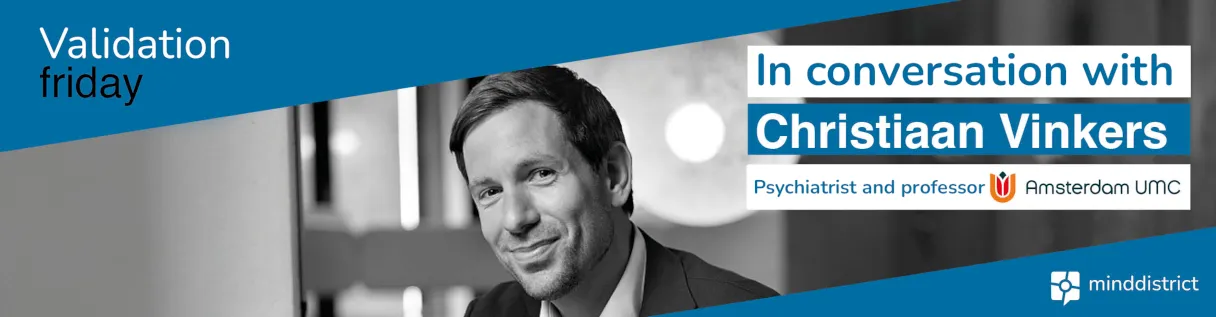
Psychiatrist and professor Christiaan Vinkers: “The image of a psychiatrist is romanticised”
The more we learn about mental health, the more we realise how little we actually know. We need to be honest about that, says Christiaan Vinkers. Precisely because there are still many misconceptions and stigmas surrounding mental health conditions and how we treat them.
Christiaan is a psychiatrist, professor and researcher at Amsterdam University Medical Center (UMC). His “claws were too big” to be a watchmaker. Via pharmacy and medicine, he more or less stumbled into psychiatry by chance. The complexity appeals to him. “Psychiatry is such a wonderfully multifaceted field, precisely because there’s still so much we don’t know about it.”
Christiaan is also an author. Together with hospital pharmacist Roeland Vis, he wrote the books "Even slikken" (“Take a moment to let it sink in”) and "Hoe zit het nu echt met antidepressiva" (“What’s the real story with antidepressants?”). In his view, antidepressants are unfairly maligned. “We discovered them by chance and don’t really know how they work. But we should be glad they exist. Antidepressants can make a noticeable difference for people with depression.”
Multidisciplinary research
He believes that psychiatrists have a significant responsibility to conduct better (pharmaceutical) research and to ensure that effective treatments are actually put into practice. Christiaan is also trying to do his bit.
Examples of this include the TEMPO study – a large-scale study into the tapering off of antidepressants – and the establishment of the "Afbouwpoli" (directly translated: “tapering clinic”) in collaboration with GGZ inGeest. People who want to stop taking antidepressants receive tailored support here, partly online via Minddistrict. Amsterdam UMC, Radboudumc, GGZ inGeest, MIND, the Nivel research institute, the Institute for Responsible Medication Use (IVM) and Minddistrict are currently collaborating on the HARMONIE study to make this approach available via GPs and mental health nurse practitioners (POH-GGZ) as well.
“Psychiatry is such a wonderfully multifaceted field, precisely because there’s still so much we don’t know about it.”

Public debate
Christiaan is not only a figure in research, academic publications and books, but also in the media. “I find it enjoyable and important, but I also see it as part of my role as a professor not just to work from an ivory tower, but to engage in the public debate.” Because there is still much to be gained in how we gather and apply knowledge. “Everyone can see that mental health care is struggling. If you want to make a difference, you have to speak out.”
That provokes reactions. Often constructive, sometimes simplistic. But that’s part of the deal. “If you stick your neck out and you’re outspoken, you can expect people to have an opinion about it. I don’t mind that either. It’s not about me or getting as many followers as possible; it’s about the content.”
That is precisely why he tries to keep the conversation constructive, even when opinions differ. “You can say: how great that you’re doing brain research, even though I’m less convinced by it myself. And vice versa: how nice that you’re looking at experiences and psychotherapy. If you do it well, it’s all valuable.” But that’s where things still go wrong too often. “Instead, we often criticise one another. That doesn’t help the field move forward.”
Less competition, more networking
What will actually help psychiatry move forward? Less competition, more collaboration. “It’s about working together and valuing the different roles within a partnership. There must be a sense of equality.” Collaborating just to secure funding won’t solve the problem, Christiaan believes. “Many partnerships break down as soon as the funding stops. There is no shared infrastructure, data remains fragmented and nobody feels responsible for implementation.” It needs to be more structural. “We need to think in terms of permanent, regional networks. With shared data, a common understanding of what works, and funding that extends beyond a single project. It was with this in mind that Depressie Net was launched: a national partnership connecting practitioners, researchers and people living with depression.
According to Christiaan, this is also where the greatest opportunity lies for improving mental health care: breaking down silos and organising the system more effectively. “You see, for example, that there is a clear divide between occupational health and curative care. They hardly speak to each other, even though they could benefit immensely from one another.” By connecting these worlds more closely and taking a holistic view of mental health, there is already much to be gained.
“Everyone can see that mental health care is struggling. If you want to make a difference, you have to speak out.”
It is just as important to make better use of what we already know. “We know that psychotherapy twice a week is more effective than once a week. Yet nobody does it.” Logistics, capacity and funding create an implementation problem. Christiaan advocates a different way of working: more data-driven and less reliant on gut feeling alone. “If you measure what you do and share that with others, people are more likely to get better. So why wouldn’t you do it?”
In practice, this proves difficult. “Many interventions sound plausible, but without proper research and real-world data, it remains unclear whether they are effective and safe.” Legislation and regulations make it complicated to take steps in this direction. “The rules are there for a reason, but it is often unclear exactly what they mean.” Together with organisations such as Minddistrict, he is looking for ways to make progress within those regulations.
Risks and romanticisation
Christiaan believes that e-health and AI will play an increasingly significant role in the treatment of mental health issues. This offers many opportunities. But the discussion often gets bogged down in the risks – and that is one-sided.
Furthermore, he feels that the image of a psychiatrist is sometimes romanticised. “We sometimes act as if a psychiatrist can see exactly what someone needs. Sometimes that’s the case. But often it’s simply someone sitting opposite you, trying to help as best they can.” Psychiatrists themselves partly perpetuate that image. “You can admit that you’re not clairvoyant and that you work with existing knowledge and protocols. You can do that whilst also paying attention to the person behind the symptoms.”
The Fall of Icarus
Christiaan doesn’t believe in the idea that success can be engineered either. “If you succeed, you write a book about it. If you fail, you were just unlucky. But that’s not how it works,” he says. “It’s mainly about persistence. You have to start something and see it through to the end. And, of course, a fair bit of luck.” The fall of Icarus is depicted on the inside of his lab coat. A reminder: just carry on as normal. “If you fly too high, you can fall a long way.”
Ultimately, what matters to him is what remains after he is gone. Networks that continue. Knowledge that is put into practice. People with mental health issues who have a better quality of life. “If the things you’ve started continue to exist without you, then that’s good.”
Would you like to know more about the tapering clinic?
Read here about how nursing specialist Kirsten Fransen experiences the tapering clinic’s hybrid approach in practice.
.webp)
Validation Friday
Improving healthcare. That’s what Minddistricter Barry Meesters works for. Just like the researchers, university medical centres and healthcare organisations he collaborates with every day. Together, they work on the development, validation and dissemination of online interventions that truly make a difference. For the Validation Friday series, Barry speaks with researchers about their personal motivations, dedication and the impact of their work.
Interested or would you like to grab a coffee with Barry sometime? Feel free to send him a message.