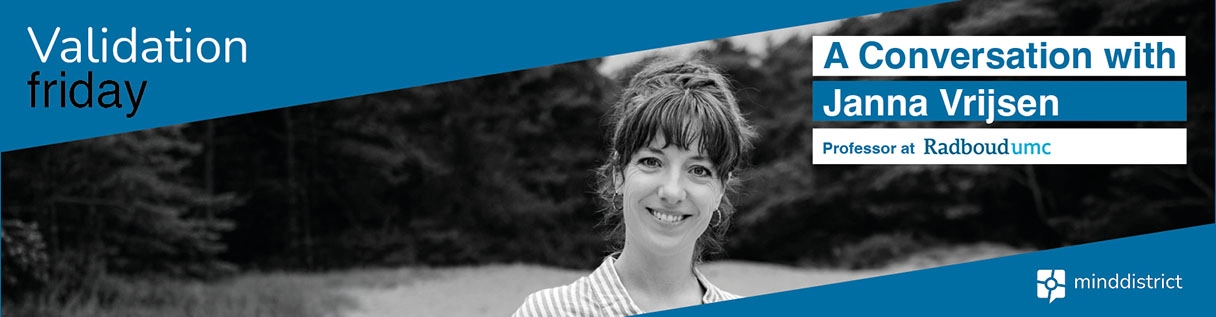
Janna Vrijsen: “Small behavioral changes can have a big impact”
Behavioral scientist Janna Vrijsen is researching how people with depression can feel better. In her work, she examines the role of sports and exercise, as well as how people think. For example, worrying. According to Janna, treatment is more effective when it addresses both the mind and the body.
“Minor differences between people, and within a single person over time, can have a huge impact in the long run,” says Janna, a senior researcher at Pro Persona and professor of Mental Fitness at Radboudumc. These differences can be found, for example, in how you process information, how your memory works, and in your behavior. “It’s not about a single moment, but about what happens when small changes persist.”
The effect of changes in a person’s life on their well-being often only becomes apparent after a long period of time. That makes it difficult to study them properly. Resources for this are also limited. “In research, a one-year follow-up after treatment is already considered good. But it doesn’t tell us nearly as much as if you could follow someone for ten years. Only then can you truly identify lasting change.”
Exercise works, but..
One of those small changes that can make a big difference? Exercise. “Research shows that exercise can be a very effective treatment for people with depression. Sometimes even more effective than medication or psychotherapy.” But people actually have to start doing it. And keep doing it. For people with depression, the barrier to even getting started is already high due to factors such as social isolation, lack of energy, and a lack of motivation to do things.
Even if someone takes that step, a positive effect isn’t guaranteed. “Suppose you go work out. Afterward, you feel better. But then you think: I didn’t do it right. Or others did better. Or it was just once.” Those automatic thoughts - cognitive biases - can immediately undermine the effect. In her research, Janna examines how that way of thinking influences the effect of exercise and the ability to stick with it.
“It’s not about a single moment, but about what happens when small changes become permanent.”
An integrated Perspective
Her interest in how people work was evident from an early age. Janna grew up with parents who worked in healthcare, but she soon realized she’d rather do research herself. “Above all, I want to understand how a treatment works, and why it works for one person but not for another.” A role as a researcher is therefore a perfect fit for her. “I’m good at dealing with long-term, slow-moving processes and maintaining my focus on the same topic for a long time,” she says.
Her work has changed over the years, though. “At first, I was mainly involved in experimental research. Figuring out how something works.” Janna now views that differently. “I think much more now in terms of: we have to make sure things actually take root. That’s why I prefer to look at: what ingredients are already in mental health care, and how can we turn them into a better dish?” At the same time, she believes that basic research remains necessary. “If everyone just wants to implement, nothing new will ever be discovered.”
In her ideal research world, we also take context into account to understand what someone needs. “In healthcare, we often focus on that one person. But there’s so much more to it. Where someone lives. Their social environment. What a typical day looks like. Even things like light or air quality can influence how someone feels and what they do.”
According to Janna, this calls for better collaboration between university medical centers (UMCs) and mental health institutions. “Everyone has a different role in this. You have to appreciate each other for the role you play in that chain. Don’t all try to do the same thing, but coordinate well and know how to find each other.”

Creating something that lasts
If she had to name one research project she’s proud of, Janna doesn’t have to think long: the Cognitive Bias Modification (CBM) tool for cancer survivors. The tool, developed in collaboration with Minddistrict, helps people who have had cancer experience fewer negative emotions and less anxiety around hospitals. “We developed it together with cancer survivors. That makes it very valuable.
“What’s more, the intervention is actually being used in healthcare. That’s not something to be taken for granted. You can make wonderful discoveries or develop treatments. But once the grant money runs out, it disappears again. And then it never reaches the people it’s meant for. With the CBM tool, we’ve created something that lasts, reaches the right people, and can even be further developed.”
At the same time, Janna remains realistic. “You’re often only treating a small part of the problem. The effects aren’t huge. But they don’t have to be.” As far as she’s concerned, the power of ehealth doesn’t lie in digitizing existing treatments. “We should first investigate how something works, and then build it from the ground up as a digital intervention.” In doing so, she sees opportunities to make interventions more widely applicable. “Many mental health issues and underlying patterns also recur in other target groups and clinical conditions.”
"Right now, we often focus on that one person within the healthcare context. But there’s so much more to it. Where someone lives. Their social environment. What a typical day looks like. Even things like light or air quality can influence how someone feels and what they do."
Doing Good, Living Well
For Janna, success is about doing the right thing. “I’ll retire satisfied if I haven’t harmed anyone and have been able to help, educate, and support many people -and if I’ve also been a good mother and partner.” In her role as a professor, she notices that responsibility feels different. “I’m more aware that my words carry more weight. I want to approach this with integrity, in a way that works for me and for the people around me.”
Want to read more?
Together with Janna Vrijsen and other researchers at Radboudumc, Minddistrict developed digital interventions for mental prehabilitation in cancer care, such as “Mindfulness for Cancer.” You can read more about this collaboration in the article [How Mental Prehabilitation Can Ease the Burden on Mental Health Care.]
“I want to do this with integrity, in a way that works for me and for the people around me."
Janna Vrijsen.webp)
Validation Friday
Improving healthcare. That’s what Minddistricter Barry Meesters works for. Just like the researchers, university medical centres and healthcare organisations he collaborates with every day. Together, they work on the development, validation and dissemination of online interventions that truly make a difference. For the Validation Friday series, Barry speaks with researchers about their personal motivations, dedication and the impact of their work.
Interested or would you like to grab a coffee with Barry sometime? Feel free to send him a message.